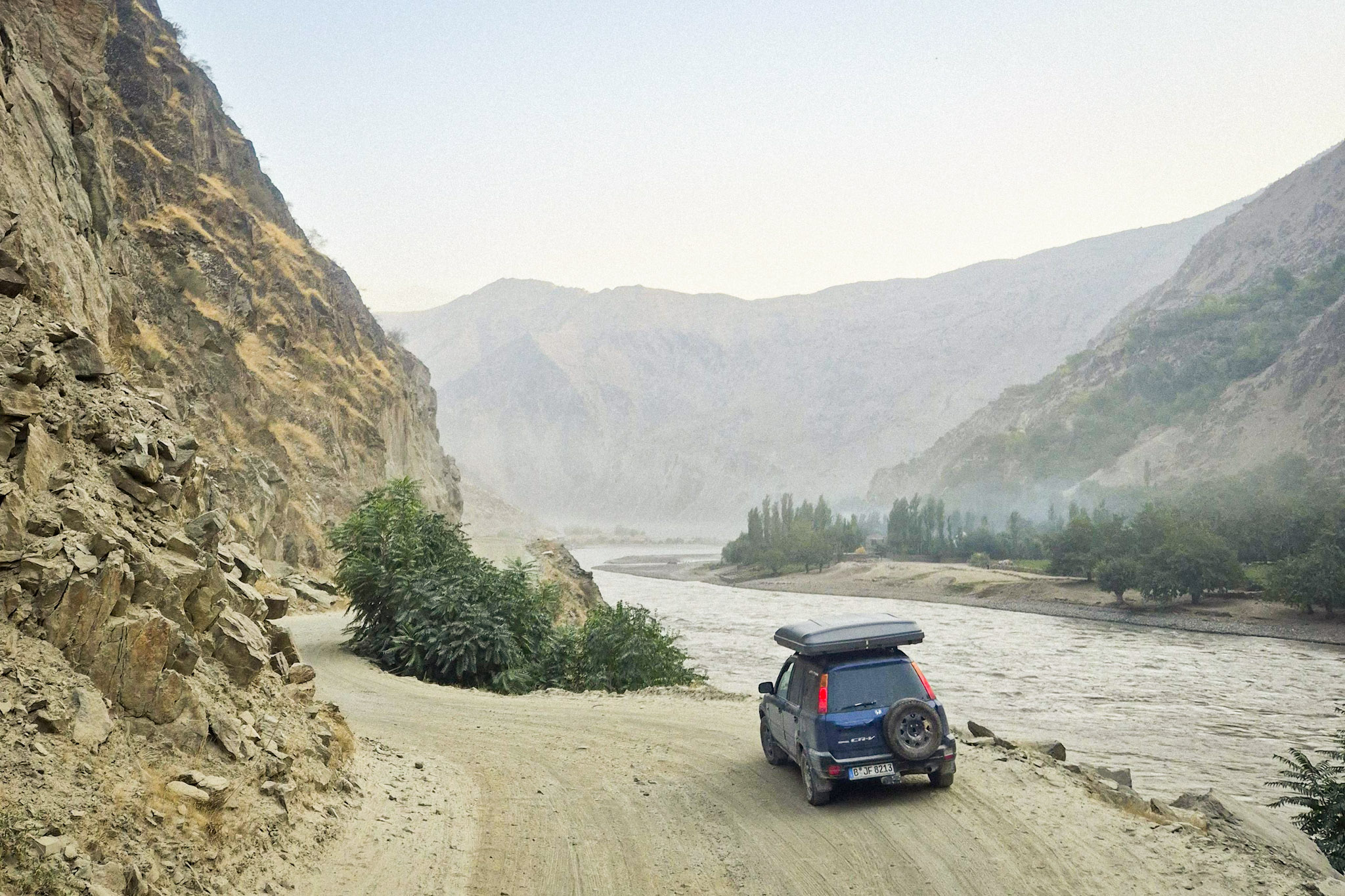
For the first few hours after leaving Dushanbe, the journey takes me through dusty, hot lowlands. This also is Tajikistan. The Honda purrs along; I’m glad the air conditioning is working. The forced break in Dushanbe and the abrupt cancellation of our original travel plans did take a toll on me after all. So I’m all the happier now to see the landscape passing by again.
Finally out of Dushanbe!
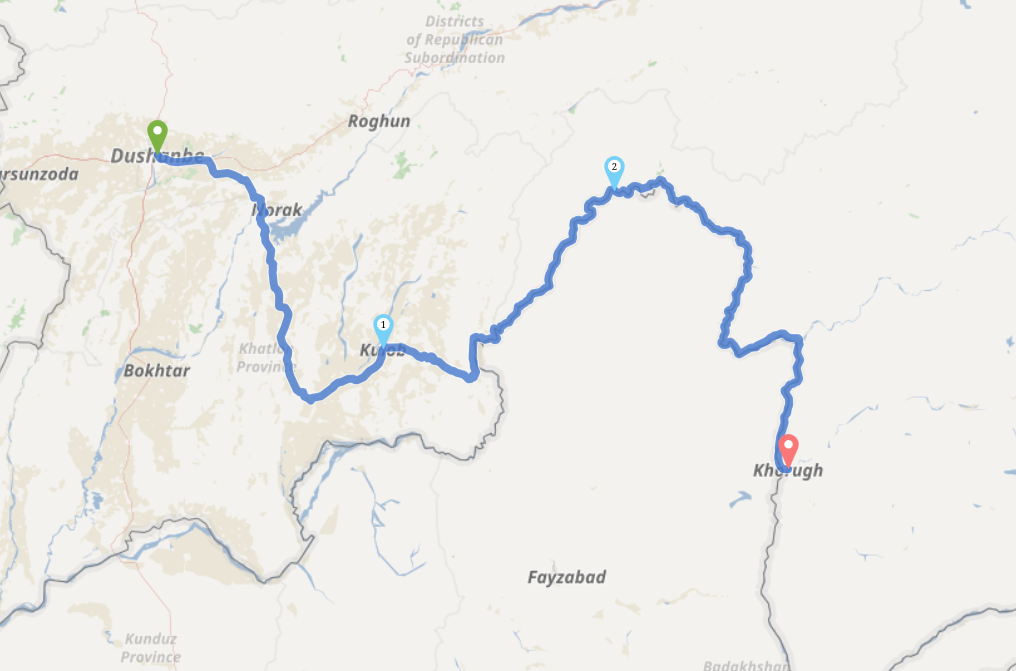
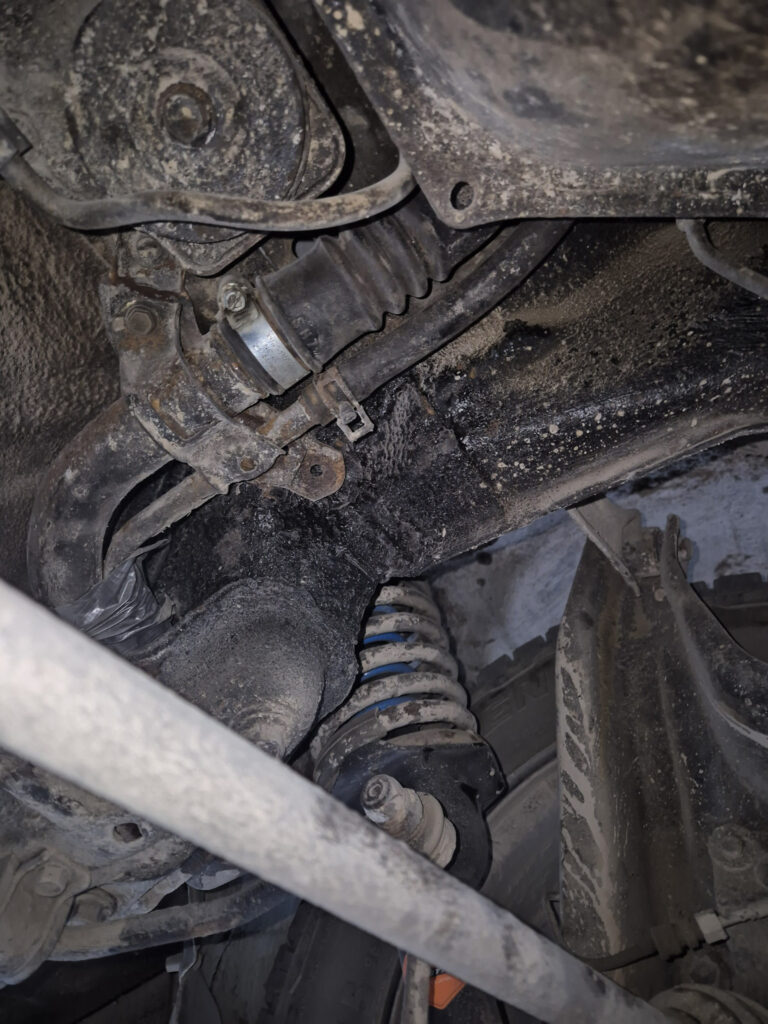
Just past the town of Kulob, the road begins to climb steadily. It heads up to a pleasantly cool 2,000 metres. The perfect time for a break. I take a critical peek under the car. The welded subframe mount still looks fine. Over the next few days, I’ll be lying under the car at every opportunity to check that everything’s still in one piece. The whole ordeal has made me a bit paranoid, to be honest.
Just after the pass, I stop at the first of many military checkpoints. I just entered the Gorno-Badakhshan region. It enjoys a degree of autonomy from the rest of the country, but the Tajik government apparently wants to know exactly who is moving where and when. As is considered best practice amongst travellers, I’ve brought a thick stack of copies of the important documents with me: passport, visa, driving licence, vehicle documents, a translation document and the GBAO permit. This saves the officers some work and will hopefully ensure a quick clearance. It works: a quick glance at the documents and the barrier opens.
The Beautiful Part of the Pamir Highway Begins
The road winds its way down the mountain. A vast plain opens up before me, framed by reddish-brown mountains. Down by the river, it’s green: the Panj Valley. The Panj is a border river; the mountains on the other side belong to Afghanistan. Before this trip, I read lots of travel accounts about this section of the Pamir Highway. In real life, it’s even more beautiful than in the photos.
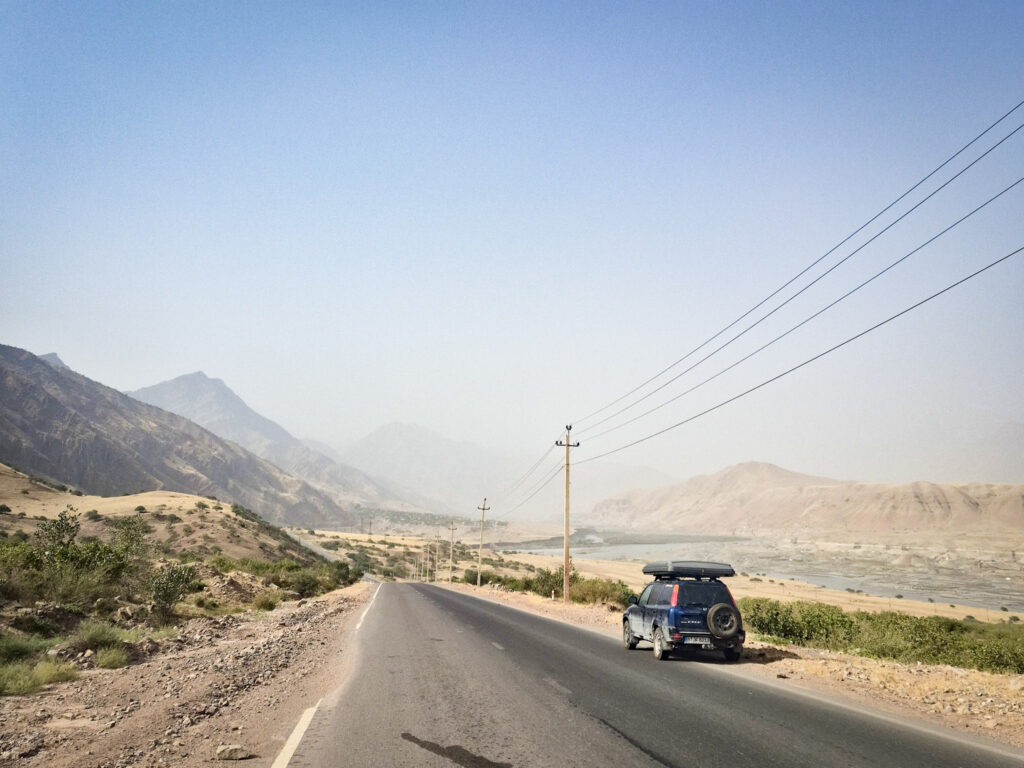
With every kilometre, the valley grows a little narrower. At some point, the Afghan bank would be within earshot if the river weren’t roaring so loudly. Having heard all the horror stories about the state of the roads, I’m pleasantly surprised by the perfectly flat tarmac. Perhaps I’m enjoying the bends a little too much. In one of the villages, I’m waved over. I did 20 over the speed limit, but the officer lets me off with a warning.
As dusk falls, I reach the town of Kalai Kumb. It’s a bustling little town. It’s actually quite inviting, but after all that driving I’m simply too knackered for the hustle and bustle. Following the overlander camping app, I drive a little up a side valley and make myself at home by a stream. As it gets dark, I’m perplexed: on what I’d taken to be a warehouse, a bright advertising sign lights up: ‘Pamir King Salmon’. I’d expected all sorts of things here, but a salmon farm?! Unfortunately, it’s already too dark to go fishing.
Things Get Wild
After a few kilometres on brand-new Chinese tarmac, the promised potholes finally start to appear. Eventually, the potholed track turns into a rubble piste with a few remaining patches of tarmac here and there. At times, I need to slow down to walking pace. Still, despite widespread belief, even this stretch definitely does not require a 4×4. The bumpy ride does have its advantages, though: at this slow pace, you have more time to enjoy the rugged landscape. Looking over to Afghanistan, the road carved into the steep rock looks even more thrilling than on this side.
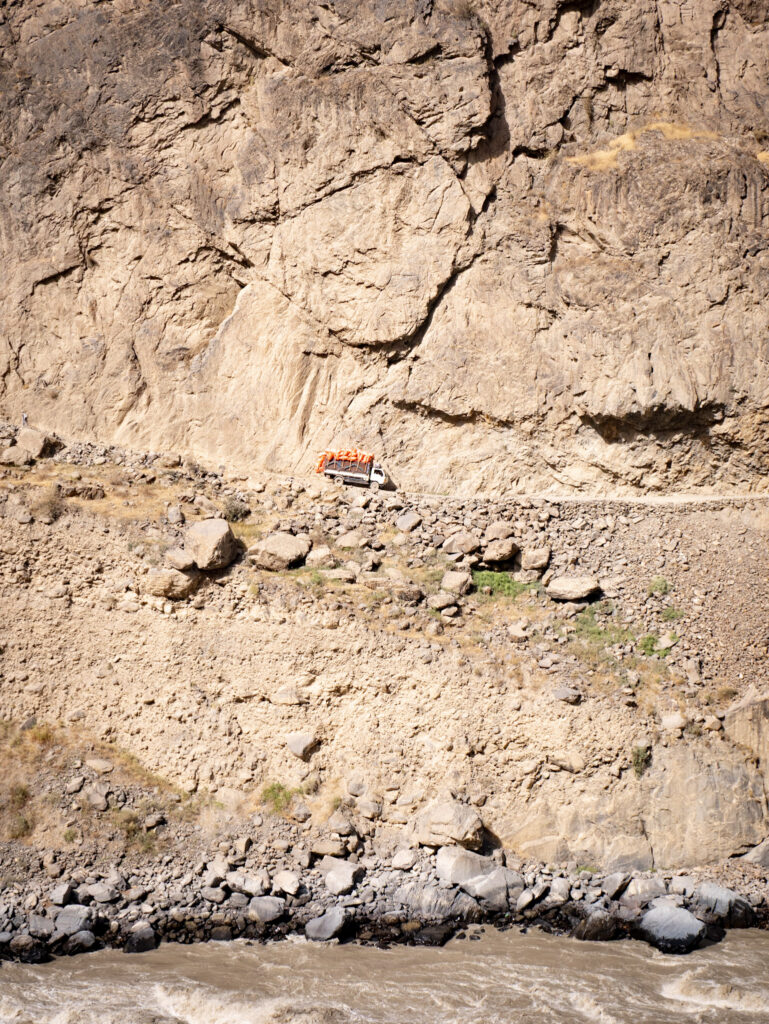
At some point, I stop at a roadblock. This section of the Pamir Highway is currently under rapid construction – as is so often the case in many countries, undertaken by Chinese road-construction companies. The rock has to be blasted away to make way for a road wide enough for two lorries to pass each other without having to manoeuvre. I’m out of luck; had I arrived ten minutes earlier, I would still have made it through. Now I’ll have to wait about two hours, as the barrier guard explains by drawing a clock in the sand. I use the waiting time for a little walk. And I notice: I’m being watched. I’d already been wondering how unguarded this border seemed to be. But now I occasionally catch a glimpse of a head in a military cap peeking out from behind the piles of rubble beside the road, only to disappear again. So it isn’t unguarded after all.
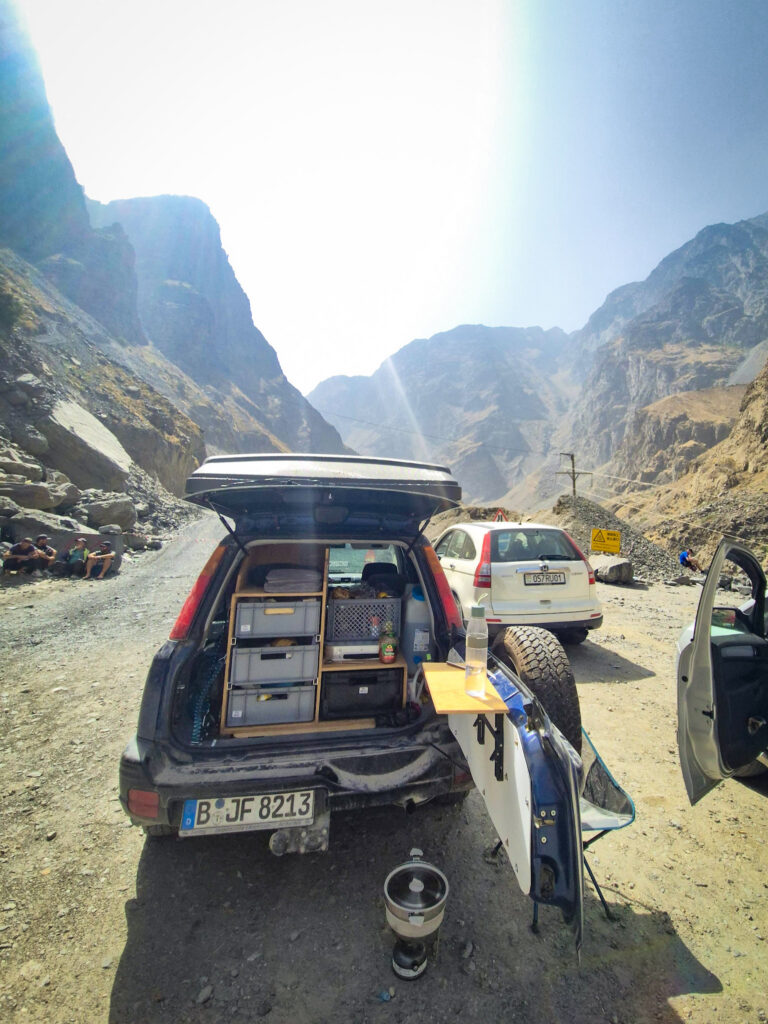
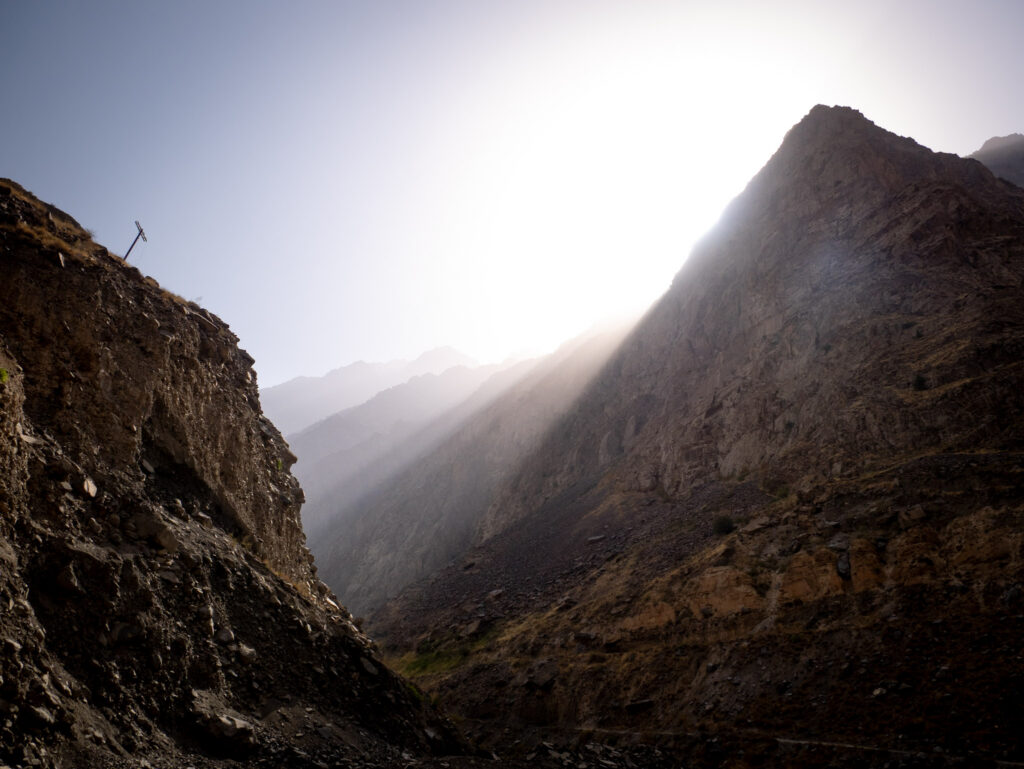
The sun is just rising behind the valley, bathing the rock faces in every possible shade of red and brown. Spray rises from the roaring river into the sunlight. I’m glad I was forced to stop here for a break; otherwise I’d probably have missed this atmosphere. At some point, a thunderous ‘Kaboom’ shakes the valley. So the blasting is underway. I return to the car and fix myself an early lunch – under the amused gaze of the other motorists who have by now piled up as well. And, as was to be expected: just as I sit down with my bowl of pasta, the barrier is raised. A construction worker gestures for me to hurry up. It looks as though the road is about to be closed again. I quickly toss my kitchen stuff into the car and speed off. I race past a large excavator 20 metres above the road, which keeps dislodging mini-avalanches towards the road.
A few kilometres further on, I stop to finish my meal. A lorry approaches from behind and stops as well. The driver shouts something I don’t understand word for word, but it’s obvious he wants to know if I’m having trouble with the car. I signal him ‘no’ by giving a thumbs-up and shaking my head. The lorry driver gives me a thumbs-up as well and drives off. There it was again – that Tajik sense of solidarity.
A Rest at the Gateway of the Pamirs
At some point, the valley widens again and the landscape becomes greener. The first villages come into view. A little later, the bumpy ride comes to an end and I’m back on tarmac. After a long day’s drive, I finally reach Khorog. Khorog is a charming little town situated at a picturesque fork of two rivers, and is the gateway to the Pamir Mountains. There are a whole host of garages and spare parts shops where you can get your vehicle ready for the rigours of the high mountains (or repair the damage afterwards). At a large bazaar, there’s a last chance before the high plateau to stock up on food, clothes, tools and all sorts of goods fresh out of China. I stock up on: a pile of root vegetables, tinned food, bread, spices, a few snacks and some canisters of drinking water. Plus windscreen washer fluid (with a raspberry scent!).
I’m staying in Khorog for one night before finally heading into the high mountains. I’m staying at a homestay that’s popular with globetrotters. Apart from me, there’s a Spanish bike-packer and a few Germans in two giant, fully-equipped travel trucks. When they, of all people, start complaining to me about how exhausting and full of hardships travelling in this part of the world is, I can’t help but smile.
Translated from German with the help of AI.
Last part: Hope and Fear in Dushanbe, Part 2
Next part: An Express Tour in Thin Air: The High Pamirs
Leave a Reply