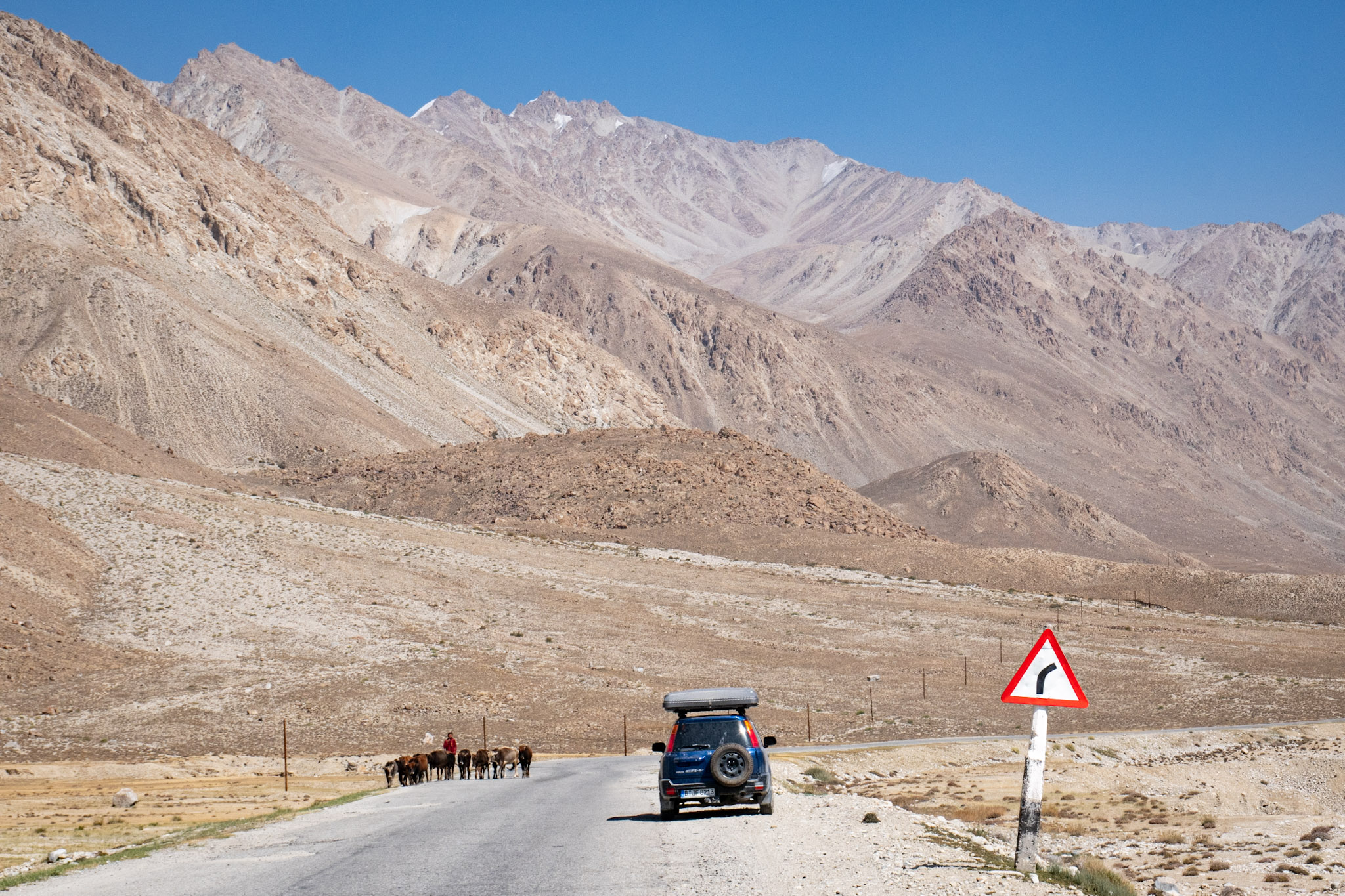
After Khorog, the road climbs steadily. The road surface bears the scars of harsh winters. But I’m still making good progress. Khorog lies at 2,000 metres above sea level, whilst the Pamir Plateau is at just under 4,000 metres. It would be possible to drive the route from Khorog up to the plateau in a single day. But I want to give my body sufficient opportunity to acclimatise to the altitude. After all, what good is the stunning scenery to me with a major headache? Before the trip, I did my research: doctors advise not sleeping any higher than 300 to 500 metres above your last overnight stop. In between, it’s fine to go a bit higher. And to drink plenty – more than you feel thirsty for. So I’m spending the first nights at 3,000, 3,400 and 3,700 metres. With my water bottle always within reach.

Potholes and Sulphur Baths
In Jelondy, just before my final acclimatisation break, I visit one of the many hot springs of the Pamirs. At first, I’m a bit puzzled: where the spring is marked on the overlander app, I find a house. I knock – perhaps someone there can help me. A man opens the door and invites me in. “The spring is here,” he gestures. “What do you mean, here?” He leads me through the living room into an adjoining room. He opens the door and I’m met by hot, slightly sulphurous steam. They’ve simply incorporated the thermal spring into their house! I give myself a quick rinse with the hot water out of a pipe, then step into the pool. The water is incredibly hot – just about bearable. After a few minutes, I dry myself off and am about to say goodbye. When I ask how much I owe for the bath, the man waves me off. On top of that, I’m invited in for coffee and some sweets. The host probably knows what a dip in hot water at an altitude of 3,600 metres can do to an unaccustomed circulatory system. With my skin feeling clean and my muscles thoroughly loosened, I drive just a few kilometres further to my overnight spot.

A few kilometres past Jelondy begins what is probably the most treacherous stretch of the Pamir Highway: Koitezek Pass. It leads up onto the Pamir Plateau. At first, the gravel track is easy to drive on. Soon, however, the potholes get deeper, the rubble coarser, and every now and then larger rocky outcrops stick out from the track. Parallel tracks branch off from the main track. Sometimes they’re significantly better, sometimes worse. Sometimes they end abruptly at a collapsed bridge. Apart from me, the other vehicles on the road here are mainly lorries, including many car transporters carrying state-of-the-art EVs from China towards Dushanbe. It’s a rather grotesque sight on a corrugated track in the middle of this remote, barren landscape. The future takes hold in Tajikistan, too.

Thrilling Tracks, Not Only for Off-Roaders
At the top of the 4,300-metre-high pass, I stop for a cup of tea. In the distance, a huge glacier shines. I can’t get enough of that view. Golden-brown marmots scurry across the rubble-strewn plains or peek out of their burrows. An old Renault 5 van rumbles towards me at a snail’s pace. I spot a Spanish number plate. Inside sits a family of six; they stop for a quick chat. It seems they’re having the time of their lives up here in their old banger. I won’t get tired of saying it: you really, really don’t need a top-of-the-range vehicle worth a small house to experience the world and to get to remote places like this. Instead of saving up for that fancy overland rig: just get going!

After three hours of nasty jolting, a convoy of bulldozers approaches from the other direction. Shortly afterwards, the corrugated track ends and a tarmac road begins. I don’t get much out of it, though: shortly afterwards, I turn off towards Bulunkul, a lake close to the coldest point of Central Asia. The record low here is minus 63 degrees! But not now, at the end of August – today the sun is beating down. The fine dust forces me to keep the windows closed, whilst the thin air means I have to switch off the air conditioning to minimise the strain on the engine and cooling system. I wouldn’t have thought I’d work up such a sweat in the high mountains. Beyond Lake Bulunkul, a track winds through an alien landscape. The ground is covered with a salty, sulphurous crust; in the valley, vibrant greens frame a river, whilst the hills shimmer in layered shades of red. The map marks a geyser. Of course, I have to see it – I’ve never experienced a geyser in real life before.
A Martian Landscape and the Power From Within the Earth

The geyser turns out to be a miniature version: from a pond the size of a baby paddling pool, a knee-high fountain bubbles up through a metal pipe every few seconds, accompanied by burping sounds. It’s rather cute, actually. And once again: the colours here! The late afternoon sun makes them even more spectacular. The smell of sulphur is a bit much, though, so I decide against spending the night next to the geothermal fountain. After a few kilometres round the hill, I rejoin the Pamir Highway. In the village of Alichur, I decide: that’s enough of driving for today. A little way above the village, I set up camp for the night.

I’m pleased to say I’m coping well with the altitude. Apart from getting out of breath more quickly, I haven’t had any other symptoms. I’m even sleeping soundly again now. But what about the Honda? It’s a cold morning at 4,000 metres. I’ve seen several YouTube videos in which overlanders have had to crank the engines of their trucks for minutes and use starter spray before the engines finally coughed to life. The Honda, on the other hand: a quick turn of the ignition key and it purrs as if nothing had happened. Up here, you’re better off with an old petrol engine than with a modern diesel.
Shopping in Containers
I continue northwards. Soon, Murgab appears on the horizon. The town is the hub of the Pamir Plateau. People on the streets are more or less wrapped up to protect themselves from the scorching high-altitude sun. At an old petrol station, I fill up the tank with 92-octane petrol. Then on to Murgab’s main attraction: the container market. As life here carries on even in freezing cold winter, there are no market stalls under awnings, but traders in decommissioned shipping and shelter containers. Apart from bread and water, I don’t really need anything, but I take a stroll around the market anyway. You can buy all the really important things here: food, car spare parts, Pokémon cards. Before I carry on, I pop into one of the guesthouses for a shower in exchange for a small fee. Not without being invited for a cup of tea by the owner afterwards, of course. It’s a real shame I have so little time. I would have loved to spend a few days in Murgab and soak up the atmosphere of the place.

I want to spend the night just before the Ak Baital Pass today, so that I can reach the top of the pass at sunrise tomorrow. I find a good spot to camp for the night next to an old caravanserai. In the distance, a herd of yaks is grazing; on the other side of the river stands the border fence marking the no-man’s-land between Tajikistan and China. It has been running alongside me for several kilometres now.
Not Just a Bucket-List Highlight

I set off at dawn. The road up the pass is nowhere near as nasty as I’d feared. Only the GPS altimeter is climbing rapidly: 4,400, 4,500, 4,600. At the pass’s saddle, it finally reads an impressive 4,663 metres above sea level. The highest point on the Pamir Highway and a new personal altitude record! The sun has just risen and is bathing the surrounding mountains in a warm morning light. I brew myself a late breakfast tea. As I stroll around on the salt-encrusted ground, the wind dies down. An incredible silence descends. Not a single sound can be heard. No wind, no birdsong, no cars. Nothing. That, and this panorama. This pass is more than just a bucket-list attraction to tick off. It really is breathtakingly beautiful up here. I savour the atmosphere for a while longer, then set off on the descent. Beyond the pass, the washboard hell opens up. Then, just before Lake Karakul, the road returns to good tarmac.

The surrounding six- and seven-thousand-metre peaks reflect in Lake Karakul. Another place where I would have loved to spend more time. But my return flight is looming. Every day I arrive earlier in Almaty gives me valuable time to sort out the storage arrangements and to have the Honda thoroughly checked and repaired before I go. So, after just a short break, I’m carrying on to the Kyrgyz border.
On Switchbacks Through No Man’s Land

A short while later, I’m standing in front of the Tajik border post. The paperwork is sorted in no time: first, my details are written down into a thick book. Then a vehicle check (including, of course, a thorough inspection of the roof tent), another paperwork check in a container office, and I’m allowed to carry on. A few hundred metres further on, I’m standing at the saddle of the 4,300-metre-high Kyzyl Art Pass. From here, it’s a few kilometres downhill through no man’s land to the Kyrgyz border post. As with virtually every section of the Pamir Highway, there are various horror stories circulating about the Kyzyl Art Pass: the road through no man’s land is said to be maintained by neither side, its condition supposedly dreadful, high ground clearance mandatory. — Well, ok. By now, I’ve developed a healthy scepticism towards such online overlander’s drama. The track does turn out to be quite bumpy indeed, but – especially now in late summer, when it’s completely dry – the little Honda does it with ease.
Goodbye Pamirs, Goodbye Central Asia
The Kyrgyz border post couldn’t be more different from the Tajik one: I’m led into a spotlessly clean counter area, where they take digital photos of my face. I’m then asked to scan a QR code to open a page on the immigration authority’s website and fill in a form there. After five minutes, I’m given the import document for the car and a stamp in my passport.

The contrasts strike me almost immediately after crossing the border: not only does the road soon become perfectly flat and almost free of potholes, but also life in Kyrgyzstan seems to be exploding: herds of horses gallop across the vast plains. Shepherds drive sheep, donkeys, cows and goats along the roads. After the days in the barren mountains, it feels as though I’ve returned to Earth from Mars.
Over the next few days, I’ll be travelling right across Kyrgyzstan to Almaty in Kazakhstan. I hope we’ll be able to make up for our plans to visit the High Pamirs next year. I’ve had the opportunity to scout the area now. That’s a good start. Because it’s one of those places on Earth that doesn’t reveal itself straight away. You have to find your bearings first. And the Pamirs are certainly a place that offers well enough to fill several trips.
Translated from German with the help of AI.
Last part: Within Earshot of Afghanistan: Along the Panj Valley
Leave a Reply