
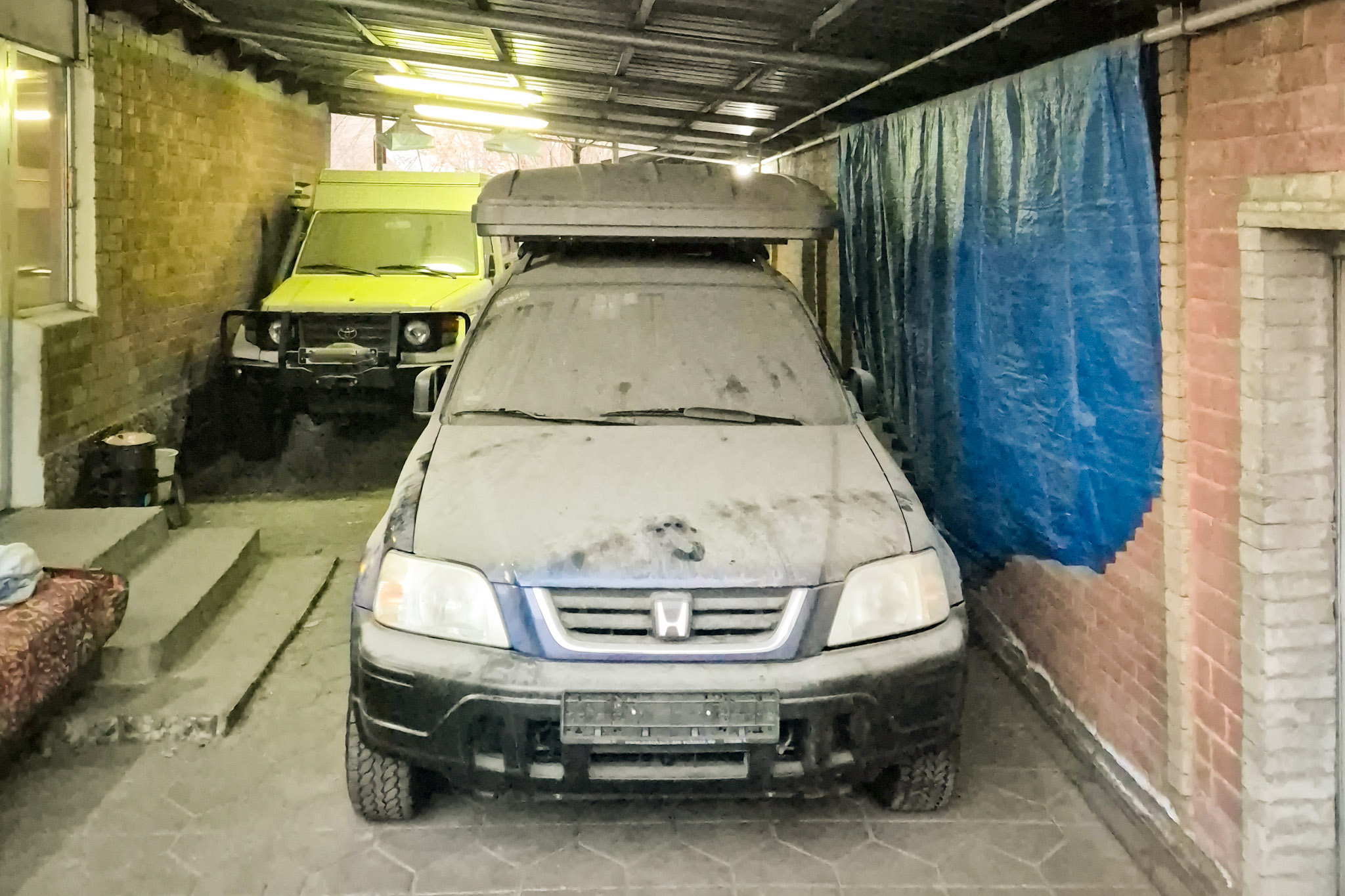
There are many good reasons for interrupting your travels. Our long journey in stages only works because we can keep parking our car abroad until we come back to continue. There are a few things to consider and also a few pitfalls. I’ve been able to gain some experience in vehicle storage and have done a lot of research on the subject. Here, I would like to pass on this knowledge. I will try to keep this article up to date. I’ll start by explaining a few basic things and then go into more detail below about the regions where I’ve either stored the car myself or researched about doing so.
The Basics: How to Take Your Travel Vehicle Into a Foreign Country
Before we get into the details and bureaucracy behind storage abroad, let’s first clarify a few basics. There are basically two ways to import a car into a foreign country as a traveller: With a Carnet de Passages or via a so-called temporary import. With both options, the time your car is allowed to stay in the respective country is limited.
Entry With a Carnet de Passages
There are many detailed sources on how carnets de passages work, such as the ADAC. Therefore, I’m not starting from zero here. In short: A Carnet de Passages is a booklet that allows you to clear your vehicle through customs in countries that accept or even require it. For getting the document, you pay a deposit to the Carnet provider. If you are travelling with a Carnet de Passages, things are simple: the period of validity of the carnet (usually one year) specifies the maximum duration of stay for your vehicle. It is usually possible to leave the country without your vehicle during this time. Depending on the country, it is even possible to get a new carnet stamped at a customs office, i.e. without leaving the country (see below), and thus keep the vehicle in the country for longer than one year.
What I found during my research: There are several lists circulating online as to which countries require a Carnet de Passages, some of them contradicting each other. In some countries on these lists, it is possible to bypass the carnet requirement, e.g. by paying a deposit or having an agent vouch for you. A more detailed research and talking to experienced travellers in the region in question may go a long way here.
Temporary Import
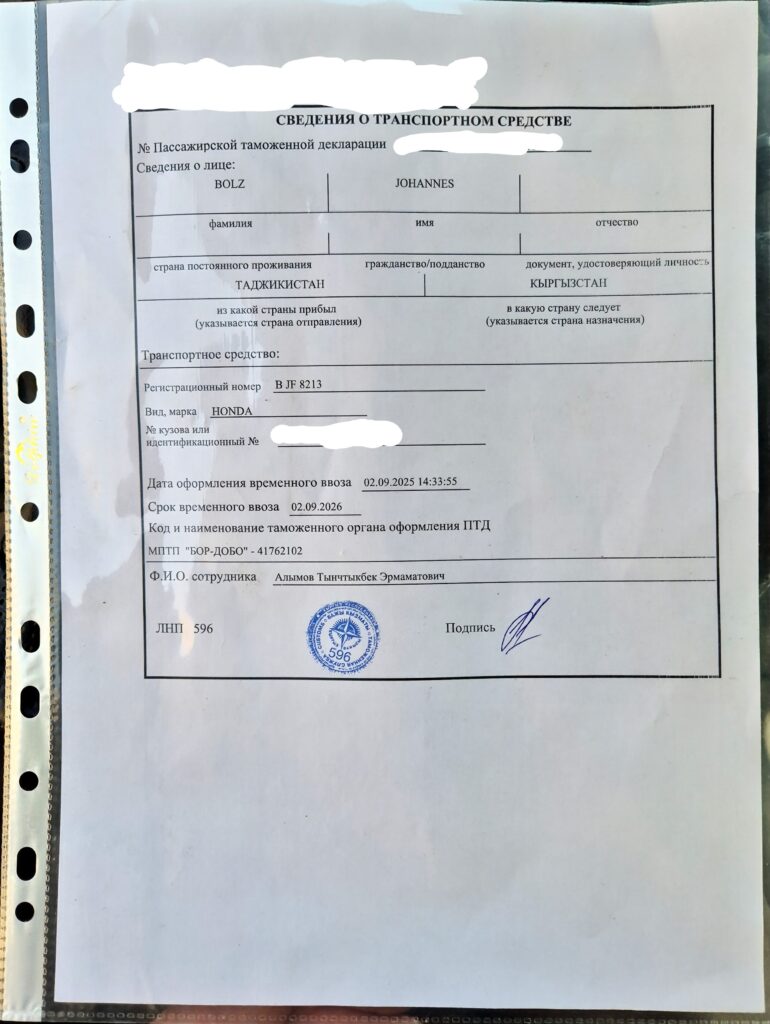
If you are only travelling through countries that do not require a Carnet de Passages, you will probably save yourself this expensive affair. Most countries allow you to import a vehicle for a limited period of time without having to pay customs duties. This is called temporary import and is sealed with a temporary import permit, or TIP for short, or simply an entry into the customs system. Each country has its own rules here. In most cases, TIPs are valid for between 30 days and one year.
Like to Stay Longer?
Do you want to stay in the country longer than the TIPs/carnets maximum duration? What foreigners whose visa is about to expire like to do is of course also possible for vehicles: a border run, i.e. leaving and re-entering the country. On re-entry, a new import document is issued or a new carnet is stamped and the time starts again. The only important thing here is to check your personal entry regulations for the country of your choice (–> Is multiple entry possible? Do you need a new visa?).
Find a Suitable Place
Once you’ve sorted out the bureaucracy, the next question is: “Where do I park my vehicle?” This can be challenging, because after all, you have invested a lot of money, effort and time into your car and don’t want to entrust it to just anyone. Also, in a foreign country you usually don’t have a network of acquaintances yet who could help. Fortunately, at least in popular overlanding destinations, you can rely on the experience of others and get recommendations for storage options. The best sources for this are regional overlander chat groups and Facebook groups, forums and special apps. Take a look at the link collection below.
All necessary trust aside: Make sure you have a written agreement with your storage operator in which you lay out the general conditions (price, duration, details of your vehicle, deposit paid, etc.) and which proves that the operator is in charge of your vehicle. Avoid making a full payment in advance. First, your vehicle is probably worth tens of times the rental price and second, this way the operator has an additional motivation to return your vehicle to you safe and sound. Also clarify whether the vehicle may need to be moved during your absence and what that may require.
Some countries have restrictions on places where the vehicle must be stored (e.g. to warehouses operated/authorised by customs). In this case, the question about finding a place becomes a lot easier.
The Costs
How much does it cost? Of course, this depends very much on the region, but also on the facility (outside/inside? heated? secured? etc), and of course how much space your vehicle takes up. In general, (Euro) prices in the two to low three-digit range per month are common. Personal examples from Central Asia: I paid 70 euros per month for a covered parking space in Kazakhstan for our Honda and 35 euros for a secure open-air space in Kyrgyzstan.
Technical Preparations
Vehicles may require different measures prior to storage. I don’t want to summarise this here with any claim to completeness. What worked well for me so far: change the oil, fill the tank all the way up with the best fuel available (prevents rust formation and evaporation of individual fuel components), inflate the tyres to the maximum pressure specified on them (to prevent flat spots), disconnect the battery. Does your storage facility have a trickle charger to connect your battery to? This way it will be freshly charged when you return.
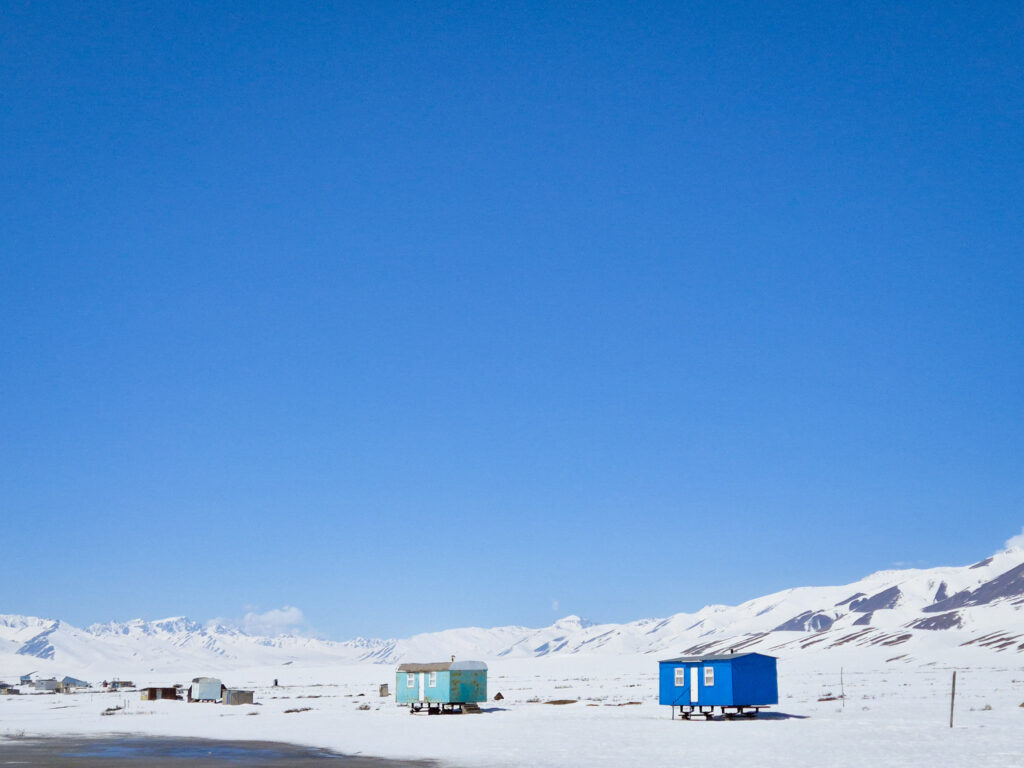
If you’re storing over the winter: check the local weather statistics! How cold can it get? Make absolutely sure that the antifreeze in the coolant is sufficient to prevent the engine from freezing. Treacherously, in some regions where the summers are particularly hot, it is also particularly cold in winter. As a summer traveller, this may be easy to miss. In Kazakhstan, for example, it can be -30 degrees or even colder in winter.
What Are the Regulations? (Europe/northern Asia)?
EU countries
As long as your vehicle is EU-registered, you have all the possibilities, as the EU’s freedom of movement also applies to vehicles. In other words, you can park your vehicle wherever you want in the EU for as long as you want, completely free of bureaucracy. (For the sake of completeness: If you move your place of residence between EU countries, different rules apply. But this article is about travelling).
According to my research, should your vehicle be registered outside the EU and you not be a EU resident either, a maximum duty-free import period of 180 days applies.
Turkey
Turkey generally allows an import period of up to three months for non residents. However, there is some red tape involved in leaving the country without your vehicle: you must obtain authorisation from the customs authorities, where you must provide a valid reason for leaving the country and specify the address where the vehicle will be stored. Note: The authorities have a record that you have entered the country with a car, and it can also be recognised by the little car on the entry stamp in your passport. So it’s best not to try your luck without going through the proper procedure. In short: it is possible, but bureaucratic. Storage in one of the neighbouring countries (EU, see above, Armenia, see below) is easier.
Georgia
Things are a little simpler here: In Georgia, you can import your vehicle duty-free for a maximum of 90 days and also leave it in the country without having to obtain prior authorisation or declare your leave. If you exceed the 90 days, a small fine per day applies, whereby the total fine is capped at a maximum amount. Some travellers simply overstay and pay the fine on exit.
Eurasian Customs Union: Armenia, Kazakhstan, Kyrgyzstan, Russia, Belarus
This is where things get interesting, especially for travellers to the Caucasus region and Central Asia. This is because duty-free vehicle imports are possible for up to one year in the Eurasian Customs Union.
This is how the Customs Union works: the member states have a shared customs territory. Goods can move freely across the borders within the Customs Union without having to pay customs duties. This is similar to the EU, although there are usually still extensive border controls.
What this means for you: The TIP that you receive when entering the Customs Union specifies the period of time during which your vehicle may stay in the Customs Union before it must be exported to a country that is not a member (e.g. from Armenia to Georgia or from Kyrgyzstan to Uzbekistan). The customs document can be issued for a period of up to one year. However, the customs officers have some individual discretion on this (for example, I was only granted six weeks when entering Belarus and a whole year entering Kyrgyzstan from Tajikistan). I have read several reports from travellers who had been granted a full year on request, at border crossings where this is not standard. So it can’t hurt to prepare a few arguments.
The Eurasian Customs Union is therefore probably the best option for storing your vehicle in the Caucasus region or Central Asia for a longer time.
Mongolia
Mongolia allows vehicles to be imported for up to one year, and there have already been travellers who were able to successfully extend the import document in the country.
Where Can I Find out More About My Travel Region?
Obviously this article can only be the beginning of your research. I would therefore like to recommend a couple of sources to you:
- WhatsApp groups: There are now dedicated overlander WhatsApp groups for every travel region, some even for individual countries. This is a great way not only to get recommendations, but also to keep up to date about the region you are travelling to. You can find a list of various groups here.
- Facebook groups: There are also Overlander groups for individual regions here. Unlike WhatsApp, they are less up-to-date, but you can browse and search through a wealth of information that has usually accumulated over years. The best way to find groups is to search for “Overlanding [name of region]”.
- iOverlander: A map-based portal for adventure travellers. On the map, you can filter by the category “Vehicle Long Term Storage” for storage facilities and read reviews from other travellers. The website is still fully usable free of charge, but the mobile app unfortunately has adopted a somewhat questionable pricing policy for a project that lives off community-contributed data.
- Forums: Yes, they still exist. And some of them have really valuable information. I can particularly recommend the Horizons Unlimited Forum (an institution among motorbike globetrotters, but open to all forms of travel and divided into regional forums), and, especially for Central Asia, Caravanistan (in addition to the forum, the site also offers a great collection of information on all conceivable aspects of travelling in North and Central Asia).
Where Have You Stored Your Vehicle Yourself?
I have stored my car myself twice so far:
Once was in Almaty with Din Jeep Trip. This is actually a local off-road tour operator. However, managing director Kristina is quite active and also offers a few covered storage lots for rent on her private property. I can highly recommend the place: Our Honda was parked there for a good six months. During this time, Kristina kept me up to date via WhatsApp, was always available for questions and also organised a trustworthy workshop for repairs and helped me with the Kazakh motorway toll (which is not quite trivial to pay).
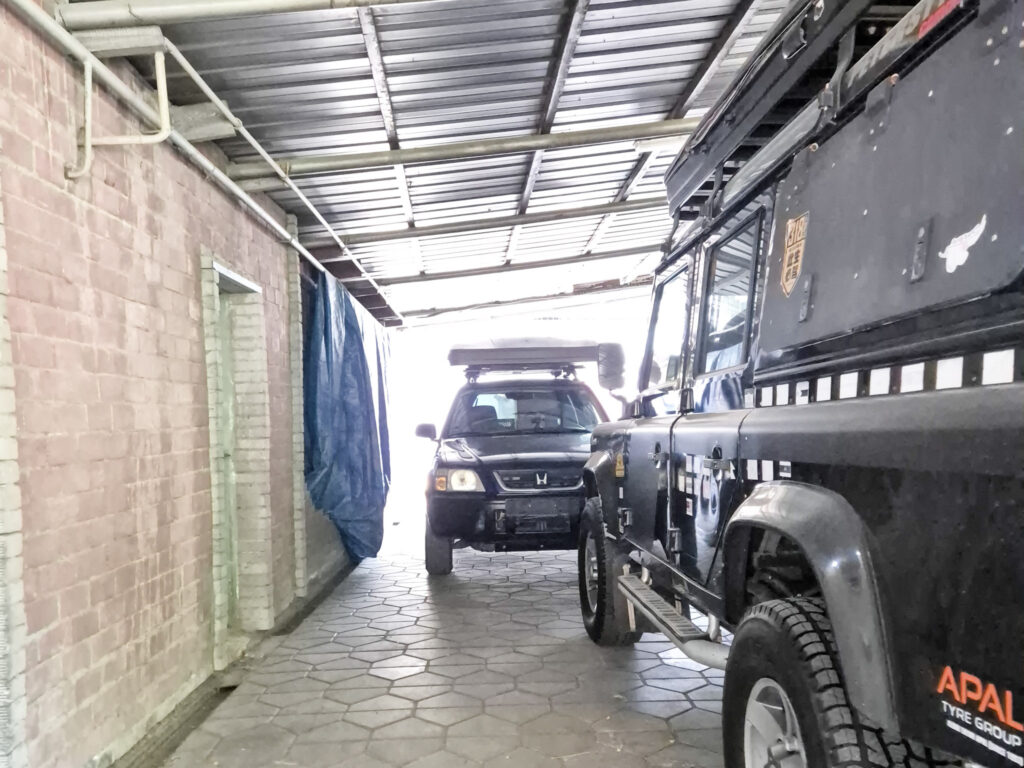
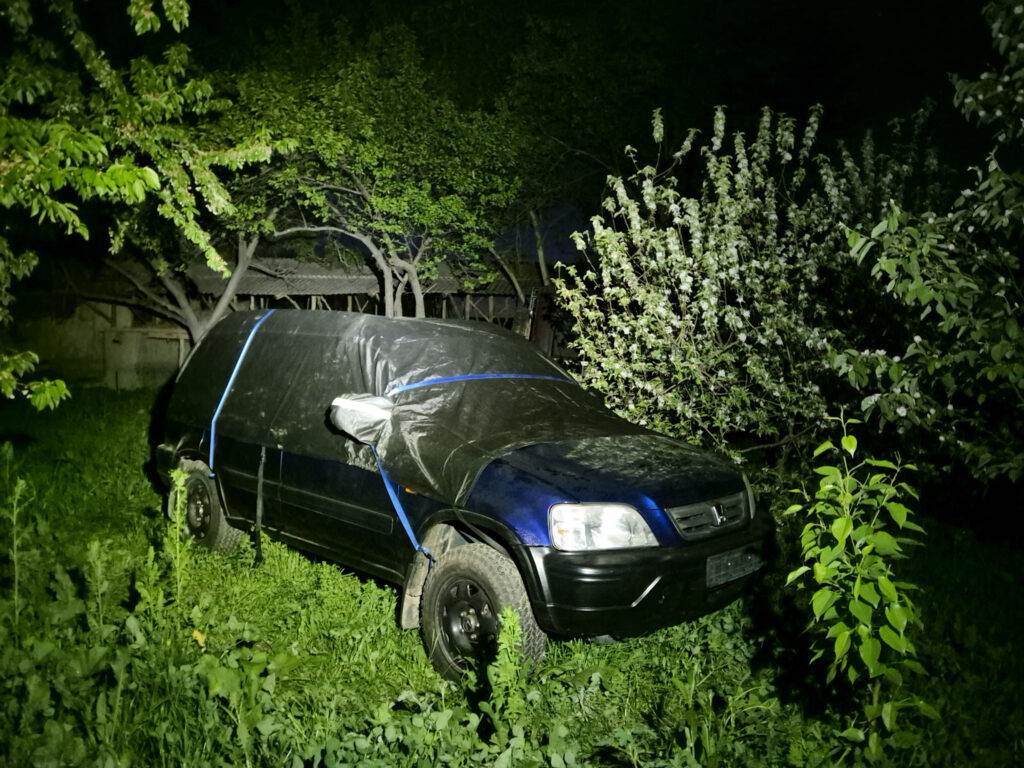
Our Honda is currently parked with Beki in Osh, Kyrgyzstan. Beki runs a campsite in the orchard and also offers pitches. As I haven’t picked up the car yet, my experience is not yet complete. But so far I have a good feeling about it. I will update the article with contact details as soon as everything has gone well with the collection. Until then, please contact me if you are interested.
Then I also know Camping 3Gs near Yerevan, Armenia. In addition to vehicle storage, it is also a very pleasant campsite with a pool and a popular watering hole for overlanders. Travelling acquaintances of ours have successfully stored their motorhome here. By the way, this is the place that in 2022 ignited our idea of travelling the world in stages!
Translated from German with the help of AI.
Leave a Reply