
Coming from Russia, the Kazakh border has a relaxed, Central Asian vibe. In the queue in front of me I spot number plates from pretty much every stan. When it’s my turn, I’m first led into a back room. The officer sitting there is obviously not in the mood for an interrogation and waves me on. I get my stamps and, that quickly, I’m in Kazakhstan!
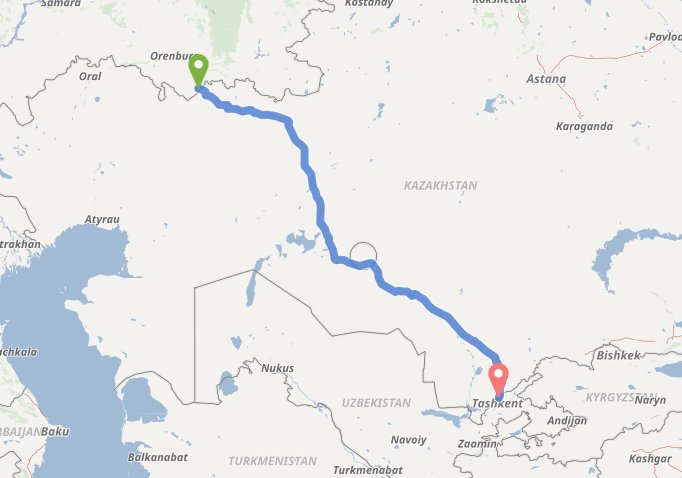
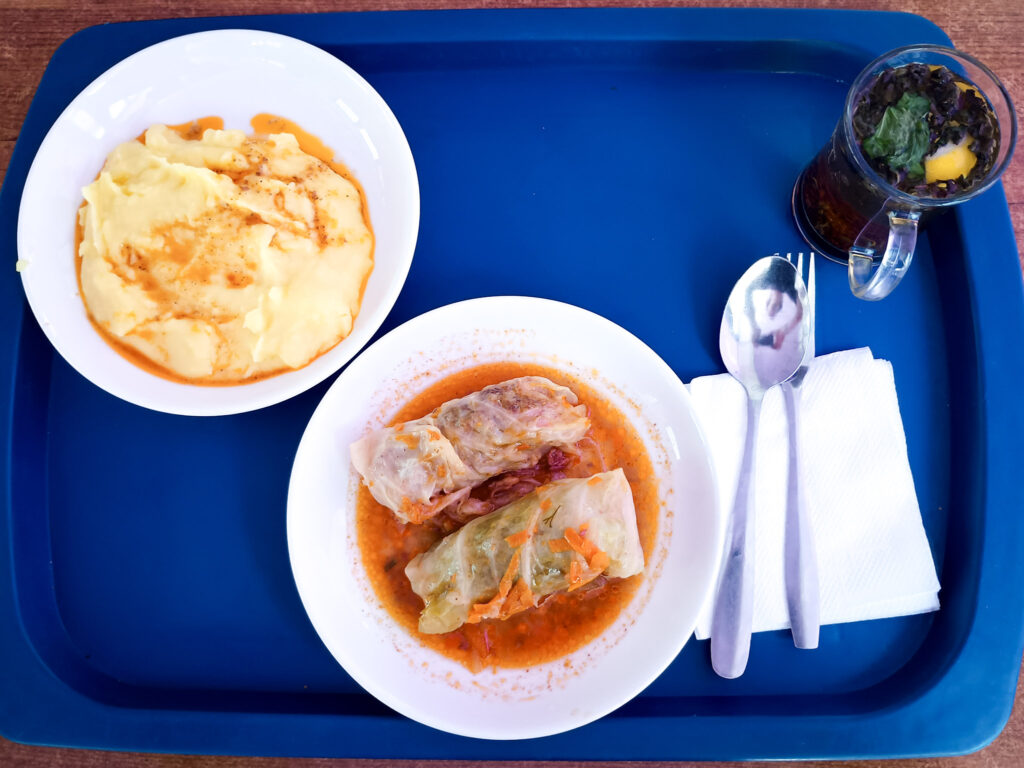
The first town after the border is Aqtobe. It’s obvious that I have now arrived in Central Asia: There is a central bazaar square with various shops and snack bars. Lots of honking and hustle and bustle. I treat myself to a lunch in one of the canteens. You can choose between various main courses and side dishes at a counter. There’s a choice of various herbal and fruit blends in glasses, which you can then brew at a hot water dispenser. I go for cabbage rolls with mashed potatoes and an orange mint tea. Delicious! With a full stomach, I decide that I’ve had enough for today and look for somewhere to stay. 16 years after my first trip to Central Asia, I’ve completely forgotten that it’s better to think twice about hotel rooms here. Most of the hotels are stuck somewhere in the Soviet Union, not only in terms of their furnishings but also their understanding of service. Private guesthouses are usually the better choice. But no matter, I’m exhausted from driving and the heat; the shabby hotel is good enough for a night. At least there’s a rumbling but functional AC and no bed bugs.
From here, I continue south-east to what is left of the Aral Sea. There have been many warnings about the first stretch of road up to the town of Qarabutaq; it’s said to be terrible. In fact, the road is quite pothole-ridden, although certainly not the worst in Central Asia. But what is treacherous: Every now and then there are stretches of really good tarmac. You quickly get a false sense of security and step on the accelerator. And then, out of nowhere, the mother of potholes appears. A couple of times, the springs bottom out with nasty bangs. Well, another lesson learnt: never trust a stretch of good road.
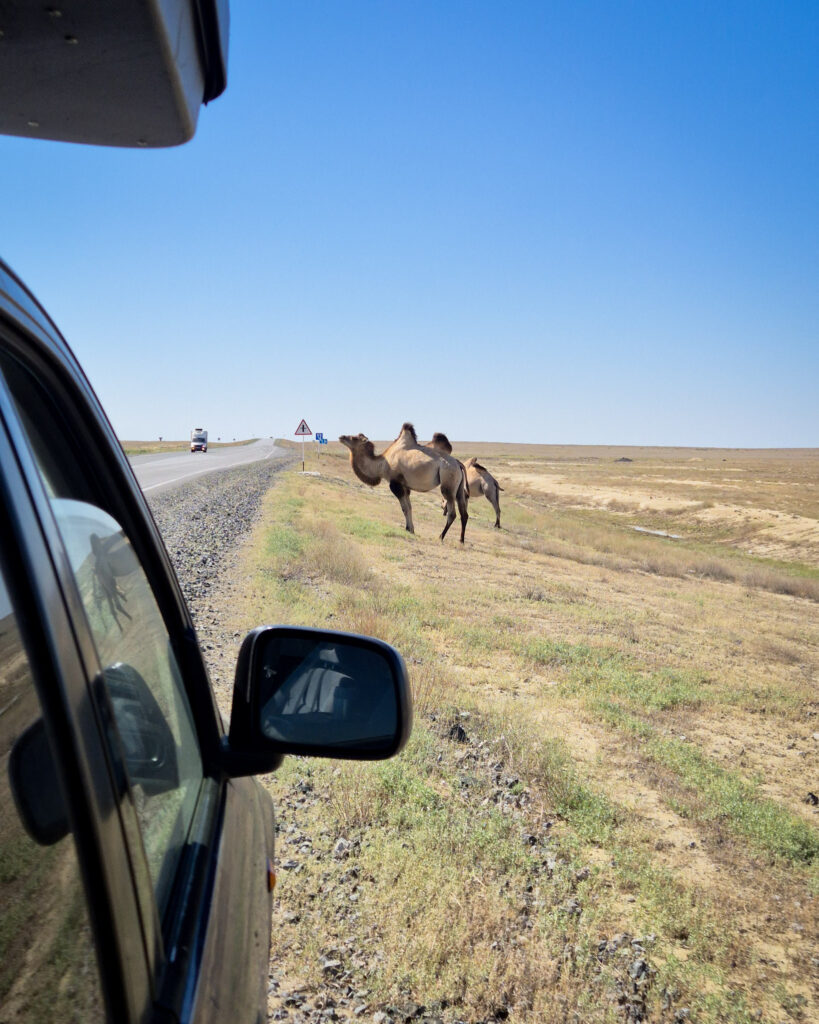
After Qarabutag, the road bends southwards and the potholes come to an end for now. The steppe turns into desert in places. Even real sand dunes appear at some point. To make it perfect: at some point I spot the first camel ruminating at the side of the road. The camels here are bigger and shaggier than those in Africa. It’s easy to believe that they have to brave freezing winters.
I set up camp for the night a few off-road kilometres away from the highway, on the edge of a meteorite crater. When the wind dies down, the silence here is incredible. And the smells: the scrub that’s everywhere here turns out to be wild thyme!
The next day, a few kilometres further south. Aral is a dystopian place. A port town without water. Docks with loading cranes standing on dry land in the middle of the landscape. All that’s left here of what was once the world’s fourth largest lake are a few ponds amidst a salt desert. In order to satisfy the Soviet Union’s hunger for cotton, the tributaries were diverted to irrigate fields. At some point, the consequences were irreversible. A pungent, musty odour lingers over the place. The blazing sun burns relentlessly, accompanied by a dusty wind. The famous shipwrecks have by now been cleared away. What remains is a small town in a doomsday atmosphere. You hardly see any people, only the occasional hooded figure scurrying through the streets. You often meet the warmest people in these uninviting places. But you have to give these places time. Unfortunately, I don’t have that now while travelling through. So I only spend a short time here before I quickly continue eastwards.
Actually, I would have liked to enter Uzbekistan by the shortest route. However, the only border crossing in the west of the country is closed due to renovation work. So I have to drive round Uzbekistan along its length until just before Tashkent, where there are still open crossings. I miss out on the west of Uzbekistan, but instead I pass by a different highlight: the Bajkonur space port. This is where the first satellite, Sputnik, space dog Laika and later the first human, Yuri Gagarin, were launched into orbit. The space port is still in operation today. Unfortunately, a visit to the Russian-operated site can only be organised for an absurdly high entrance fee and with a lead up time of several months. Nevertheless, the area is absolutely worth a visit: next to the checkpoint at the entrance gate, there is a small exhibition with replicas of Sputnik, Proton rockets and other space vehicles. A few stray dogs chill out among the rocket and satellite models. I wonder if they are Laika’s great-great-great-great-great-grandchildren? Regardless of their family background, I give the dogs some of the dry food I have on board for my dog-crazy young co-pilot.
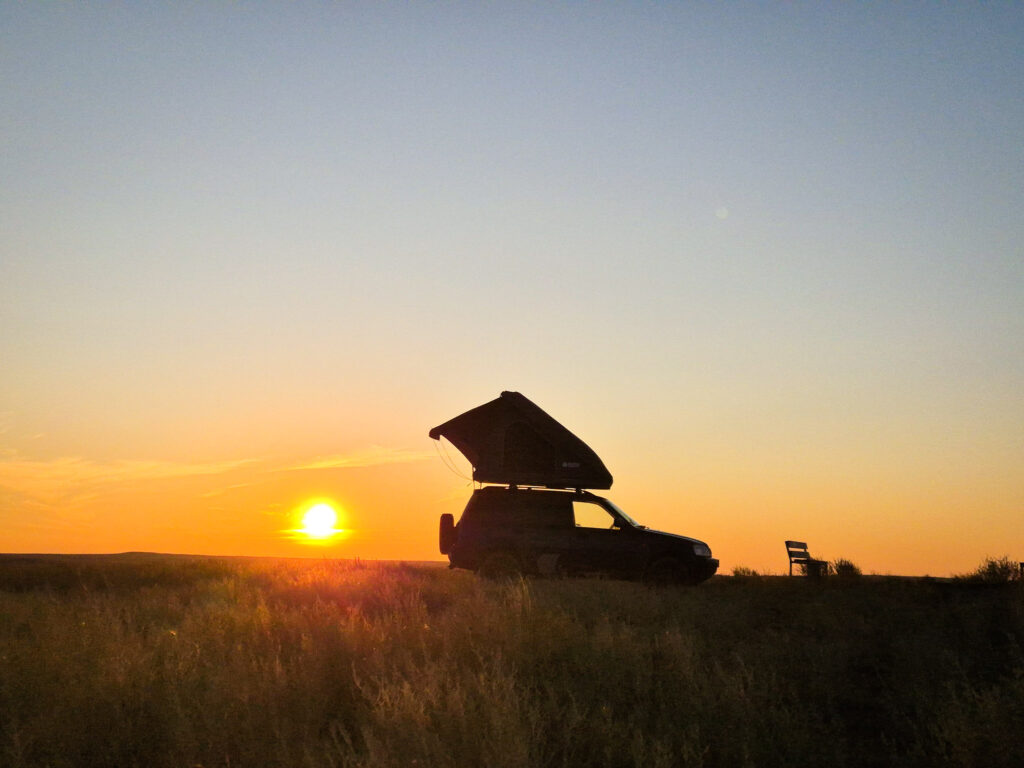
The camp spot app shows a small hill nearby, which is said to offer a magnificent view of rocket launches. I park up next to the hill for the night. Unfortunately, no launches are planned for today. Nevertheless, the view of the huge parabolic antennas of the command centre pointing vertically into the sky is an experience. Also the fact that you can just camp here. No high-security area, no barbed wire, no patrols. This place will definitely make it into my personal top ten of campsites. After a picture-book sunset over the steppe, an impressive view of the Milky Way opens up. The stars are close here indeed.
Translated from German with the help of AI.
Next part: Borderline Crazy: From Kazakhstan to Uzbekistan
Previous part: A Transit in Difficult Times: Russia
Leave a Reply