
When you’re travelling fast like I am on my way to Samqrqand, you spend a lot of time at borders. Sometimes more, sometimes less. Today it will be more. I’m travelling from my overnight camp near Shymkent to the Uzbek border, expecting a easy crossing from Kazakhstan to Uzbekistan — two countries that don’t have too many problems with each other.
I arrive at the Kaplanbek border just before Tashkent at around 10am. I’m shocked: the traffic jam in front of the border area already extends 200 metres into the town, in three to four lanes. In between, there is a constant stream of pedestrians getting across by foot. The sun blazes already. Wild honking. A few self-appointed traffic marshallers ensure that the town doesn’t get completely blocked by all the cars and that the crossroads remain clear. For now, patience and a cool head are required. Well, as cool as possible. I strategically position the car in the far left lane. That way, I can simply get out when at a standstill and squeeze into the shade under the tiny trees on the median along with the other people waiting.
A conversation that I’m going to have repeatedly in a similar form during the trip: “You come from the land of Mercedes, BMW, Audi. Why on earth are you driving a Japanese car?” asks the old gentleman in the 190 Mercedes using the translator app. Well. I reply, half jokingly, half seriously: “The good — i.e. old — German cars are all in Central Asia now and the new ones are rubbish.” — He’s satisfied with my answer. Central Asia’s roads really are like a time machine: some of the fleet of vehicles seems to have been teleported here directly from my childhood. However, it is currently being rapidly replaced by modern Chinese EVs.
Somewhere ahead in the queue, someone starts the engine. I am warned to sit in the driver’s seat, ready to go at the same time as the person in front of me so as not to leave a gap that someone else could use for themselves. You’ll meet the warmest, most helpful, most hospitable people in Central Asia. Until they get behind the wheel. Then they fight fiercely and with full use of the horn for every inch, every second, every place in the queue, as if it decided wars. Fortunately, as soon as the engine is switched off, the metamorphosis is reversed again.
After three hours, I’m finally standing in front of the large metal gate, through which a handful of cars are let through at a time. It’s not just me, but also the other people waiting, whose brains have slowly been cooked in the heat. The atmosphere becomes more aggressive. At some point, loud bickering between three flying money changers turns into a full-blown brawl. In the end, there are banknotes lying on the street and the money changers are busy reorganising their takings. Thanks, I’ll wait for the next cash machine then.
The Kazakh border guards are in a good mood despite the heat. The paper map of Central Asia (am I the only one who still drives around with one of these?) arouses particular interest. The chief inspector takes the opportunity to open it up completely on the bonnet and show me his home town. Otherwise just a few questions, a look at the car, a stamp, that’s it. On to the Uzbek side.
The absurdity of the Uzbek border is reminiscent of the office building from that one Asterix film. The first official hands me a process slip that needs to be stamped by various officers and sends me to the first station, the vehicle import booth. The building has two counters, one on each opposite side. In a system that I cannot get behind, repeatedly one window closes and the other one opens. Each time, the congregation of car import candidates waddles around the building and reorganises themselves in front of the now open window. — There is no such thing as proper queues in Central Asia. It’s best to forget about this concept altogether. When I make my way to the front, dissapointment: I have to get a different slip from a neighbouring building first, the inspector tells me, waving his arms about. Good thing I’m on holidays and have time. So off to the neighbouring shack it is. For some reason it’s not at ground level, but some kind of watchtower that I first have to climb up to via stairs. Inside, a young Uzbek who thankfully speaks English explains to me that I have to pay a road tax first. He takes my documents and types into his computer, which then spits out a QR code on the screen. I have to take a picture of it with my mobile phone, go to the payment booth, have it scanned and pay. I then have to take the receipt to customs. Well, now I’m on a run!
The payment counter is located behind a window at about waist height. To speak to the employee sitting inside, you have to assume a confessional-like posture in front of the window. Oh almighty border guard, forgive me for the disturbance and please let me pay. Preferably by card. I submit the QR code, documents and credit card and receive the long-awaited road tax slip. Now it’s off to the alternating customs windows again for the import document.
In the meantime, a sizeable group of mostly Uzbeks and an overlander from Russia has gathered there. Together with him, I slowly fight my way up to the window. The official keeps taking documents from the Uzbeks left and right, ignoring my Russian brother in suffering and me. I watch the spectacle for a few minutes, then loose my cool and find a few loud and clear English words for the sluggish border guard. The Russian flinches. Was that really a good idea? With a loud sigh, our papers are accepted and import documents stamped. It worked after all.
With the stamped paperwork, I first head through the vehicle inspection and then into the immigration hall. One last check, the process slip is collected and I am finally allowed to continue my journey. I have spent eight hours at the border. Longer than at the infamous border with Belarus. It will remain a record on this journey.
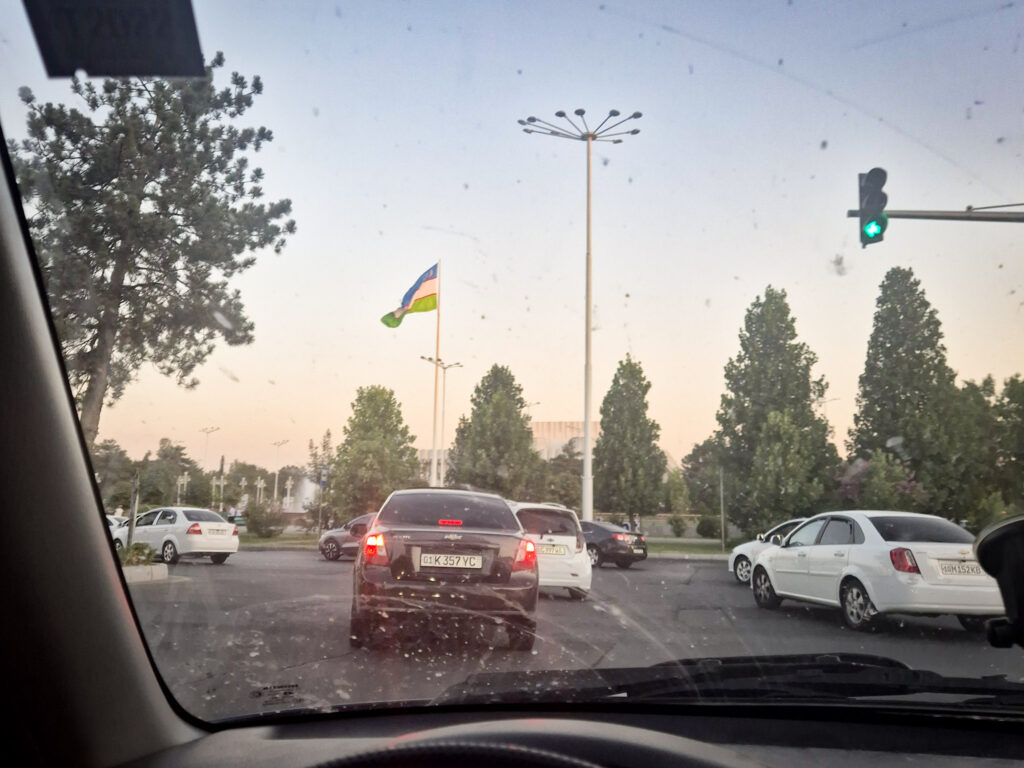
Behind the last barrier, touts trying to sell me car insurance are knocking on the window. No, not with the best will in the world. With the air conditioning on full blast, I drive off towards Tashkent. I’ll get insurance tomorrow in an air conditioned office.
The plan for tonight: shower, beer, dinner, bed. In that order.
Translated from German with the help of AI.
Next part: Turning onto the Silk Road: Tashkent and Samarqand
Previous part: In Laika’s Footsteps: Kazakhstan
Leave a Reply