

Anyone following me on Instagram has already seen the cat jump out of the bag: Our great journey in stages begins in Central Asia. For adventurers from Central Europe travelling with a vehicle, the Stans are the perfect choice: Accessible without ferry crossings or overly complex customs bureaucracy, yet a completely different world in terms of landscape and culture. Above all: really, really beautiful. A younger version of me backpacked through Kyrgyzstan back in 2009. As exciting as the journey in rickety Audi shared taxis and crammed-to-the-roof marshrutkas (overland minibuses decommissioned in Europe) was back then: I always wished we could stop spontaneously at the bend with the great view or next to the yurt by the lake and set up camp for the night. In other words: travelling here with our own vehicle and being completely free to decide when we stay where and for how long. Now, 16 years later, we want to follow up on the idea and travel Central Asia with out own vehicle.
The plan for the first leg of our big journey in stages: I set off alone from Berlin and drive 6,000 kilometres to Samarqand in Uzbekistan. The young and the tall co-pilot will then fly there from home. Together we want to explore Samarqand and western Tajikistan, and finally drive along the Pamir Highway all the way to Kyrgyzstan. At the end of the summer holidays, I’ll drive on — alone again — to Almaty in Kazakhstan, where I’ll store our car until next year.
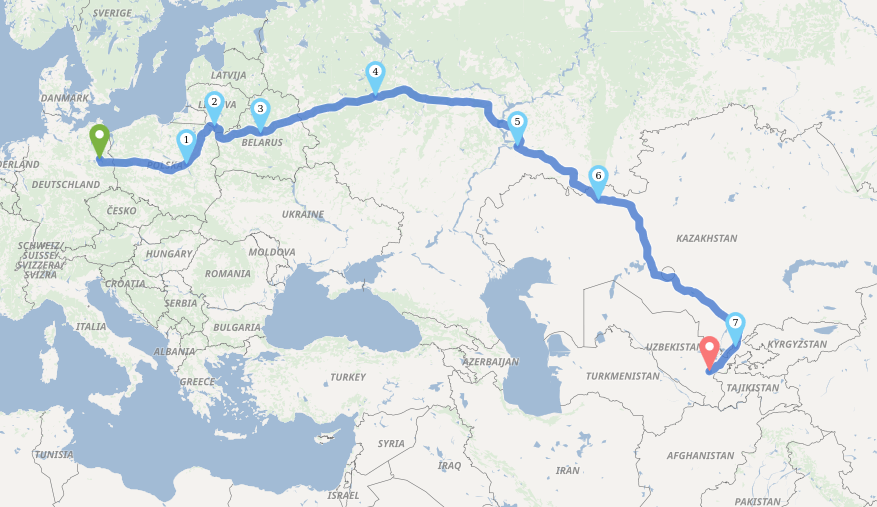
But back to the preparations. The first hurdle is at home: If you want to travel from Germany to Central Asia nowadays without too much of a hassle, you can’t avoid going through Russia. You basically have the choice of either travelling a relatively long distance through Russia on a northern route via Moscow, or a shorter transit south between Georgia and Kazakhstan along the Caspian Sea. As I will be travelling with limited time, I opt for the northern route via Moscow, which is about a thousand kilometres shorter in total.
Despite the war, Russia is not making it any more difficult than usual for travellers to obtain a visa. Which is not to say that it is not complicated! — It starts with the fact that you have to be invited to Russia to get a tourist visa. How practical (or mafia-esque?) that some travel agencies have specialised in issuing these invitations for money. So I get the invitation and all sorts of other paperwork and take it to the office of the contractor in Berlin that accepts visa applications on behalf of the embassy. A week later I have the visa in my passport.
The bureaucracy associated with travelling (through) Russia may seem intimidating at first. But a little research quickly takes the fear out of the whole thing. Irena’s website russiable.com is a great source of all kinds of information for travellers to Russia.
Then there’s a whole rat’s tail of research: Where is the best place to enter Russia? (Spoiler: There are no really pleasant and fast border crossings coming from the EU. If the border procedure only takes hours and not days, you’re on the winning side). What questions at the border should I be prepared for? Where do I leave Russia? What papers do I need, how does it work with importing the car? How do I deal with the money if I am not allowed to export Euros but cannot get money from ATMs in Russia because of the sanctions? (Answer: A not too small bundle of dollars that would be sufficient for unplanned emergencies). The research beforehand is always an interesting part of travelling for me. But this is really something else.
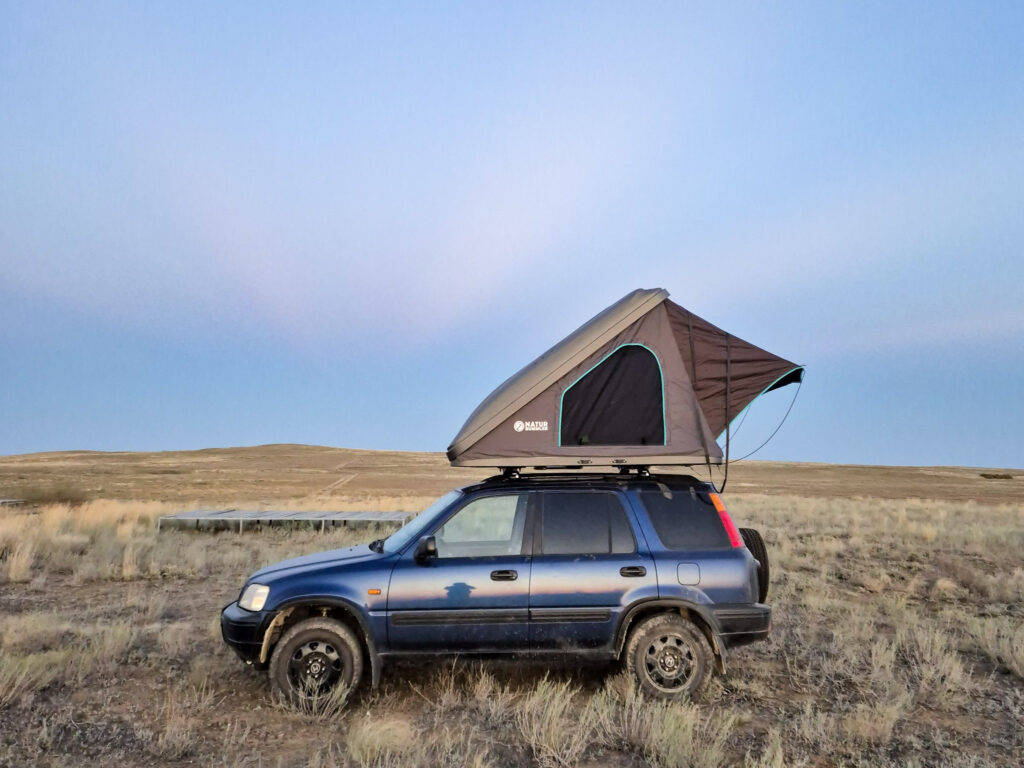
Over the last few months, I have prepared our vehicle, a 1998 Honda CR-V, for travelling: I’ve replaced pretty much all the wearing parts and engine attachments as a precaution, fitted stronger springs, put on good off-road tyres, installed a eurobox shelf and a simple power supply with power banks, and put a large roof tent on top. And of course fixed all sorts of little things that need to be fixed on a 27-year-old car. At this point, I’m glad that I’ve had a couple of years of experience travelling with various camping vehicles: I have a good sense of what we will need, what is useful and what is superfluous. So, I don’t have to worry about whether the setup will really work for us. I think the Honda is the perfect car for us for the long journey: Just big enough for three people and luggage, with durable and simple Japanese 90s mechanics, sold worldwide and off-road capable enough for pretty much anything coming your way, as long as off-road driving is not the purpose of the journey itself. And, also quite important, it wasn’t too expensive, so I can still sleep well when the car is parked somewhere far away while we are at home.
The Honda is packed and ready to go. Clothes, camping gear, provisions, electronics, all kinds of paperwork, maps, water, dog food for strays. I get behind the wheel with anticipation and a little respect for the long journey.
Article translated to English with the help of AI.
Next part: About Stalin’s Pipe and Siberian Sweets – a Day in Belarus
Leave a Reply