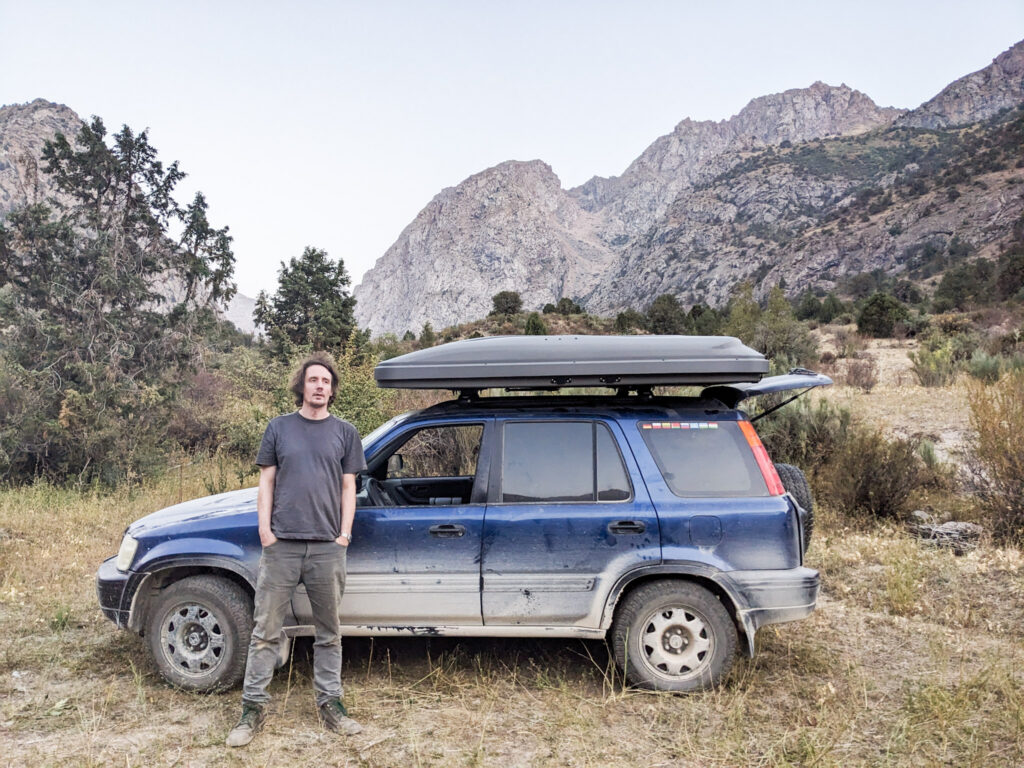
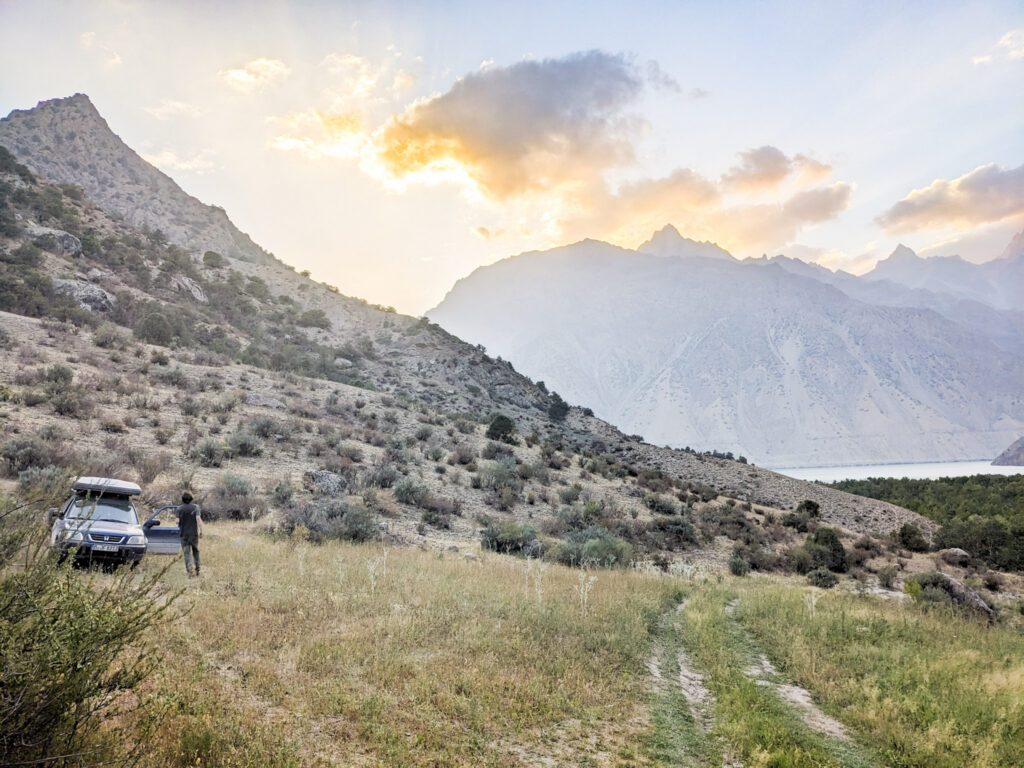
A long day behind the wheel, a nasty track, fatigue and a few stupid decisions was all it took. Now we’re standing there, on a mountainside in the middle of nowhere. The Honda is parked with a damaged drivetrain on the least steep part of mountain meadow I could find. Tea water is boiling on a fire made of twigs. Now, of all times, we’ve run out of petrol for the cooker. Time to take a deep breath and brainstorm how we’re going to get out of here.
What Happened?
A few days ago, we set off from the Seven Lakes to Iskanderkul, a large mountain lake halfway between the Uzbek border and the Tajikistan’s capital Dushanbe. The track to the lake was easy at first, our Honda pulled up the gravel switchbacks like a mountain goat. Tajikistan’s dictator president also appreciates the picturesque lake and has built a country residence on its shores. Up to there, the road was fine. After the residence, however, the track became narrower and narrower, the rubble looser, and in some places even our small vehicle barely made it between rock overhangs and the steep slope down to the lake. It was already late afternoon, but the overlander app promised a picturesque spot at a white beach at the other end of the lake. We had almost made it, I circled the Honda down a steep path between rocks protruding out of the track. Suddenly, three figures appeared in front of us. Two Czech hikers and a young Tajik goatherd. They looked worried. The young man’s mother apparently had some kind of medical emergency and they were out to get help. Due to a lack of language skills (he only spoke Tajik), he used his hands, feet and finally a drawing to give us some idea of the nature the problem. He asked for a phone. After a short call on a poor connection, he didn’t seem to have gotten the help he needed. We discussed. The sun had already set. Heading back towards civilisation on the narrow rocky track alongside the cliff in the dark was no option. Two or three kilometres ago, a large overland truck was parked a little way off the path. I thought I saw a satellite internet antenna on it. The three of them decided to hike to the truck to hopefully get better communication options. We continued down the slope. Once at the bottom, there was still a short path through a forest to the lakeshore. By then it was almost dark. The path became softer and softer and eventually led through reeds. Less than 200 metres before the lakeshore, there was a small muddy section. The ruts had been dug deeper by heavy off-road tyres than our small SUV’s ground clearance. But the ground looked pretty soft. So: gaining momentum to hopefully just slide over the soft mud it was. It worked, in the sense that we got through the mud hole. What I had missed, though, was a tree stump hiding in the mud between the tracks. We hit it with a nasty bang. Oh crap! I went under the car with a torch. The steel bash plate that I had fitted before the journey seemed to have done its job and absorbed the impact, judging by a few scratches and a slightly bent fitting. Well, if that’s all it is!
A Panorama Worth The Journey
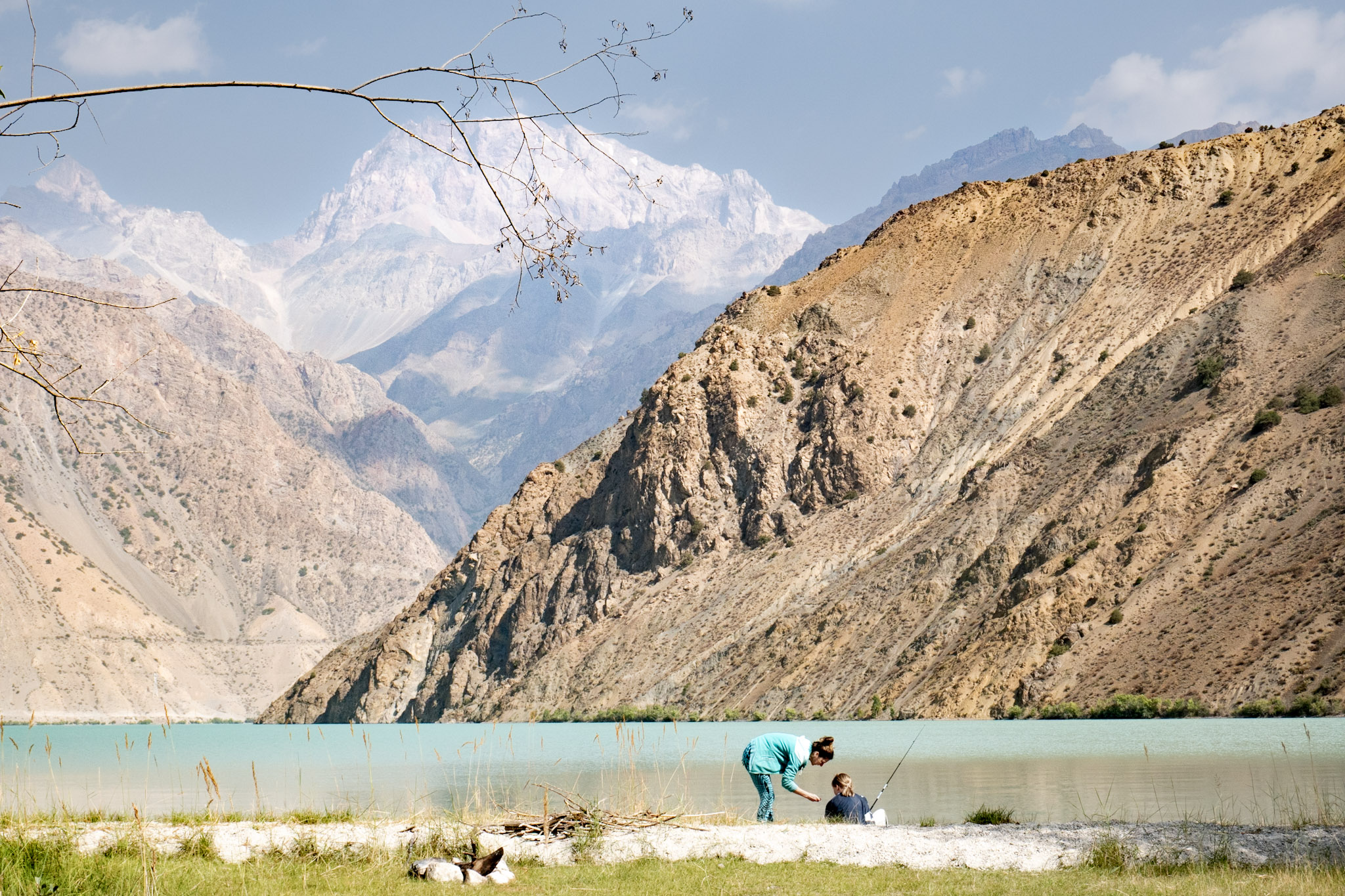
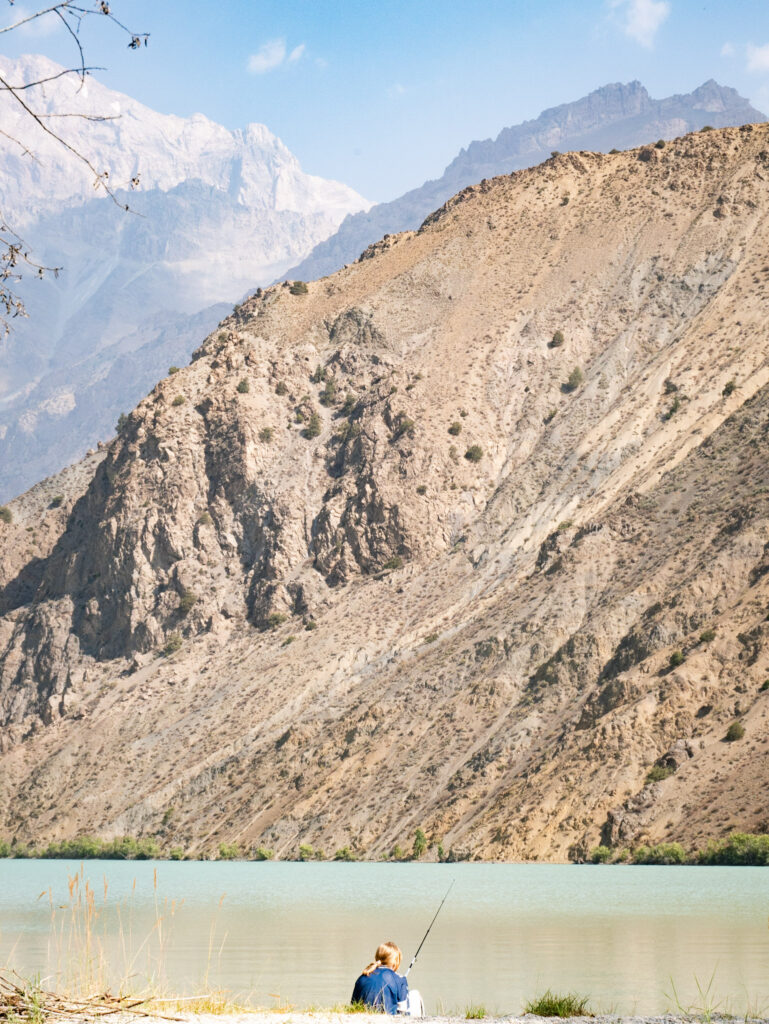
The next morning we realised that our efforts had not been in vain: A lonely, white beach, clear blue water and silence. I felt a little reminded of the New Zealand Southern Alps. We hung up hammocks, cast the fishing rod and chilled out. Central Asia can be so relaxing! The only time I felt a little uneasy was on a walk through the forest when I spotted a huge bear turd in the middle of the path. I spent the walk back to camp whistling and singing to myself (never surprise bears with your presence! learnt from the best). On the way past the muddy section, I had a hand-in-the-face moment: I could have simply ridden slightly off-centre, flattening the reeds and instead of speeding through. Note to self: Only ride these kind of tracks 100% rested. And, in doubt, overnight before the picture-book destination.
Well rested, we set off for Dushanbe two days later. Driving back through the forest was a non issue. But then, when the front wheels lost traction (and the four-wheel drive was supposed to kick in) on the first gravelled incline, the drivetrain started cracking and stopped propelling the car. Oh no! What broke? The gearbox? A wheel hub? The differential? One thing was for sure: I was not going to drive on like this until we knew what was broken, as to not make the problem worse. So I let the Honda roll back to an open stretch of grass. The co-pilots had walked up the slope and witnessed the spectacle from the outside.
How Do We Get out of This Mess?
You can’t just call the roadside assistance here. The way up to the main track is a few hundred metres long and involves some very steep, loose rubble. And nasty rocks sticking out of the ground. At least a heavy 4×4 will be needed for a recovery. But how to get hold of one?
The big co-pilot has the right idea: we still carry old-school travel guidebooks. These usually list accommodations with telephone numbers. We look up the nearest town, and sure enough, there are a few guesthouses with a telephone line. Our cellphones sporadically show one bar here on the hillside. After a few attempts, we get through and actually get someone on the phone who speaks some English. The guesthouse hosts are super helpful and promise to send help by 4×4 tomorrow. What a relief. We’ll get out of here again! How exactly, we’ll see. For now, we enjoy the sunset. Because despite all the drama, the view over the lake from our emergency bivouac is gigantic. We enjoy the views with a Russian pine cola.
Despite the incline, the crew sleeps well. After a quick breakfast, we prepare everything for a recovery. I already attach a rope to the front of the Honda. Then it’s waiting. After a while, we hear an engine in the distance. An old Toyota SUV, no bigger than our Honda, is slowly making its way along the rubble track above the lake. How do they want to pull us out with that? A short time later, they are standing in front of us: two Tajiks, a driver, a mechanic. Time for an initial diagnosis. I explain with my hands, feet and making sounds what the problem is. I’m told to accelerate to reproduce the noise. Meanwhile, the mechanic lies down next to the car, watches and listens. “Kchrrrrr”. Again. He shakes various drivetrain parts. The mechanic’s verdict: the prop shaft has had it. When we hit the mud, the tree stump must have hit the joint where the shaft is made up of two parts. What now? The mechanic explains to me (still all in hands and feet and three words of English) that the car can still be driven in front-wheel drive. In other words, so that the rear wheels are not bothered to engage when the front wheels slip. But how to do that on a steep incline full of rubble, where many 4×4 drivers would engage low range? With momentum! And with as little weight as possible. Piece by piece, we load as much weight as we can from our Honda into the Tajiks’ car.
Escape With Full Throttle
The mechanic offers to drive the Honda out for us. Thanks, but if there’s anyone who’s going to destroy the car, it’s me. I walk up the steep section again. I memorise every rock that sticks out of the ground and plan best line to take in order to preserve as much momentum as possible through the steep sections. Back to the car and off I go. With a lead foot, I take off on the somewhat flatter first few metres. Then comes the first steep section. “Kchrrrrrrrrrrt!” Too slow. I roll back onto our overnight spot off and reverse up the meadow as far as I can. And again, full throttle! With the engine screaming, the Honda ploughs up through the rubble, bouncing like a wild rodeo horse between ruts, washouts and boulders. After a minute, it’s over and I come to a halt at the junction with the main track. The car is still intact, I’m full of adrenaline. I shout to the others, “I made it up!!!”. Our rescuers and the two co-pilots follow in a much calmer pace. We drive back around the lake in convoy up to the presidential palace, where the narrow gravel track becomes a passable piste.
Tajik Cameraderie
We stop to reload our luggage. Time to pay our helpers. We didn’t negotiate a price in advance. I ask. “500”. Does he mean dollars? I can’t blame them, but I ask again to be on the safe side. No, he means Somoni! That’s less than 50 Euros. For taking up half their day. We have a feeling that they wanted to help us out of our pickle first and foremost. Tajikistan is poor, but the people stick together. We will encounter this special cameraderie repeatedly over the rest of our journey.
We are glad to have tarmac under our wheels again. On the advice of the mechanic, we continue at a decidedly leisurely pace towards the capital, Dushanbe.
Translated from German with the help of AI.
Next part: Hope and Fear in Dushanbe, Part 1
Last part: Seven lakes and a bumpy track: Arriving in Tajikistan
Leave a Reply